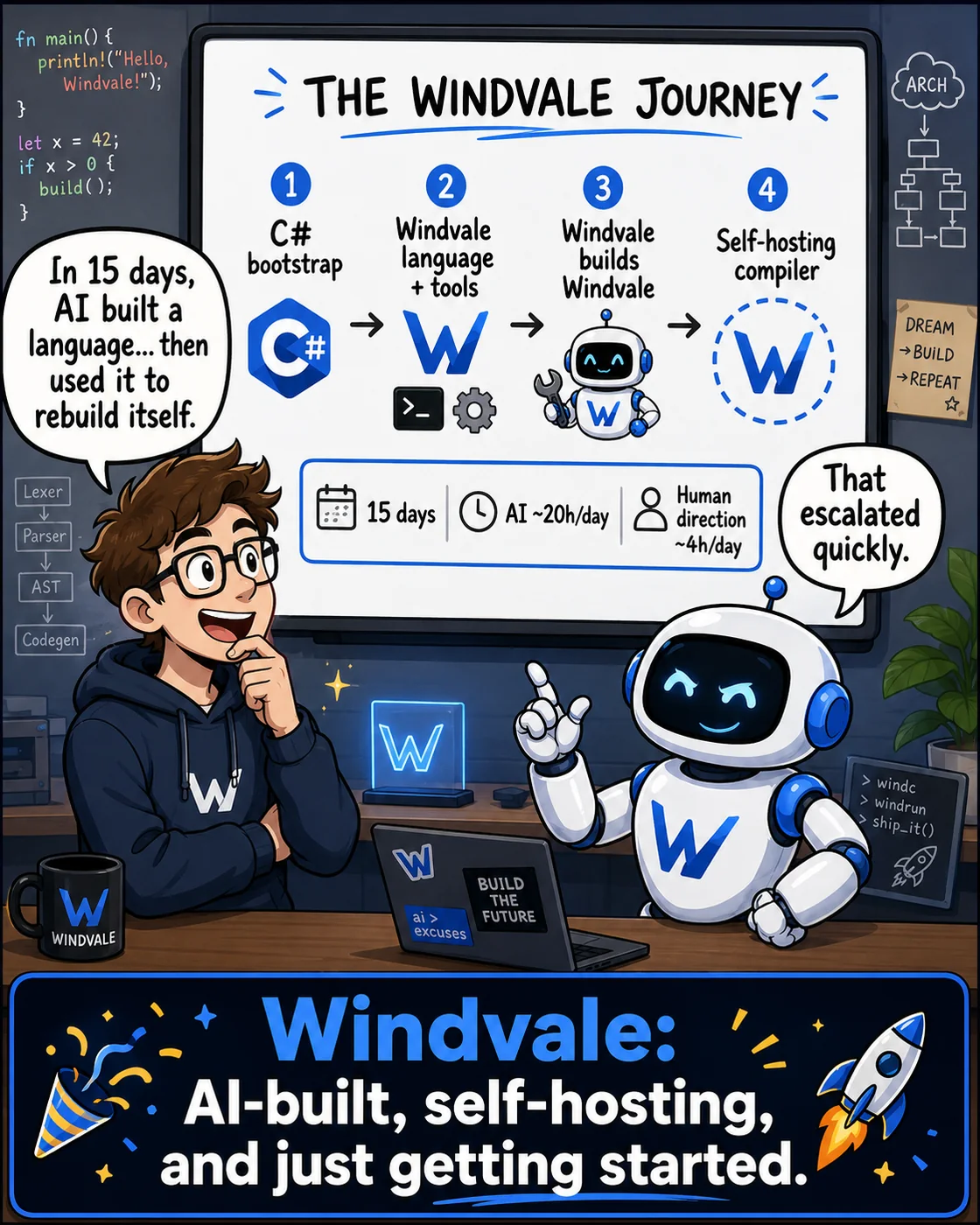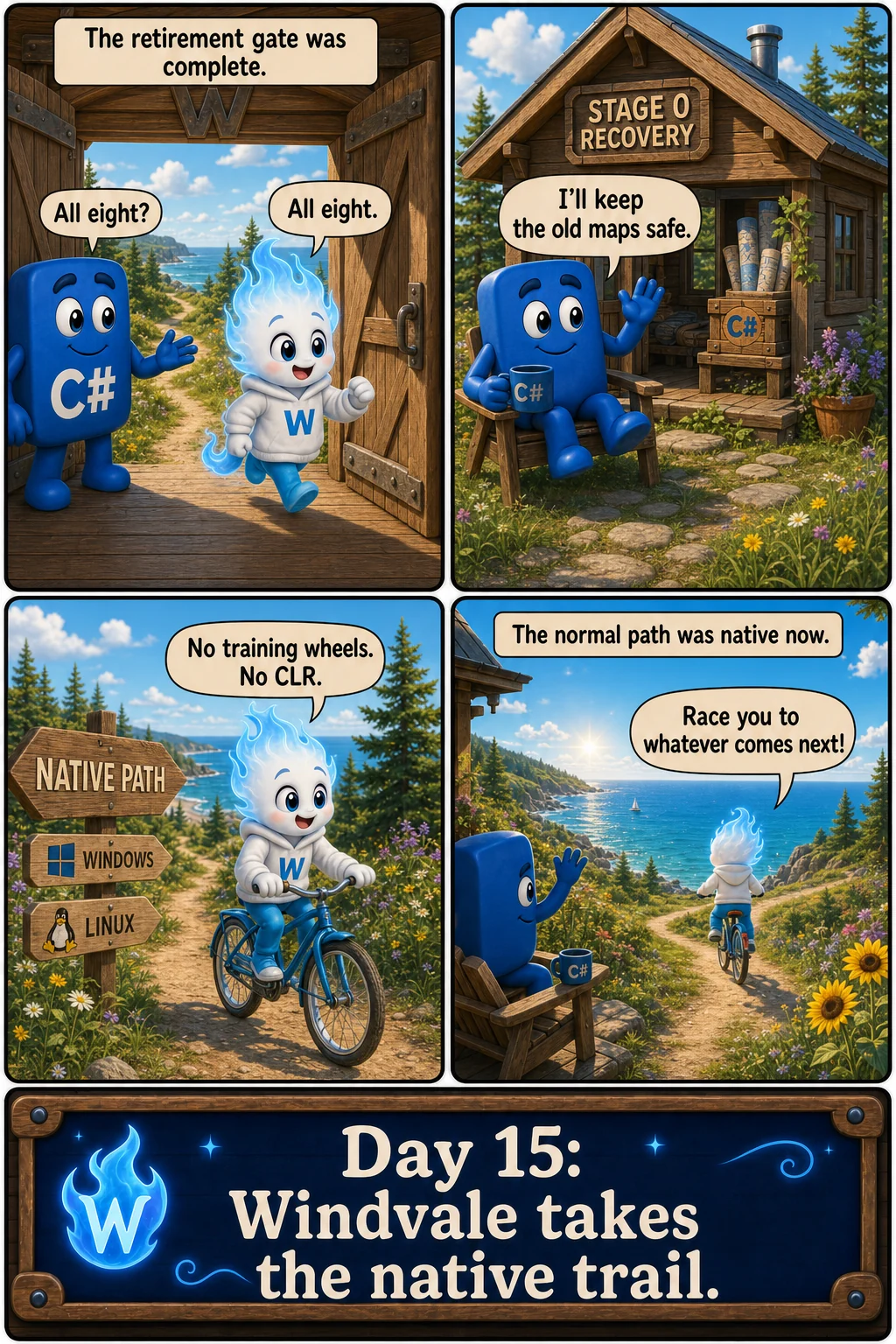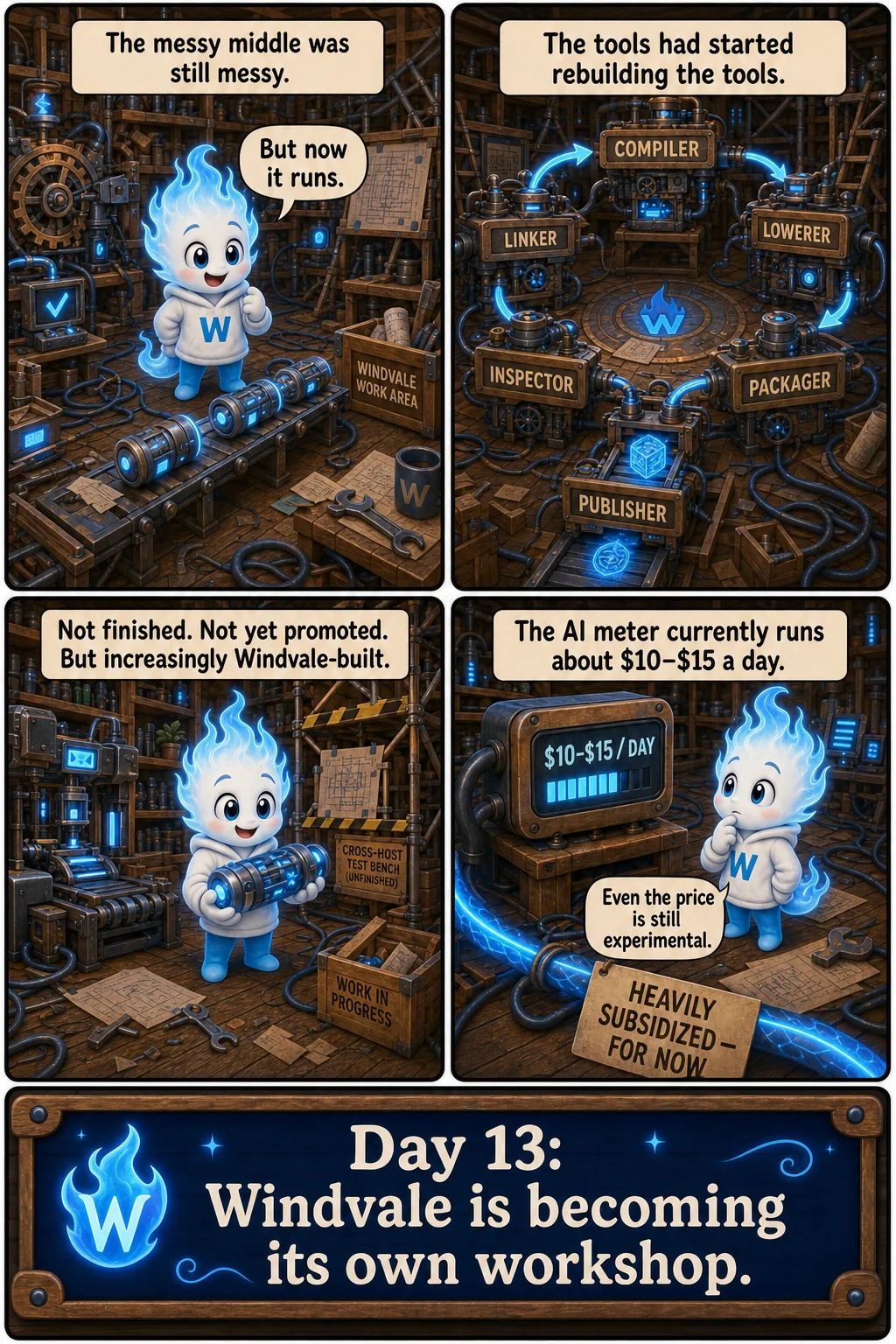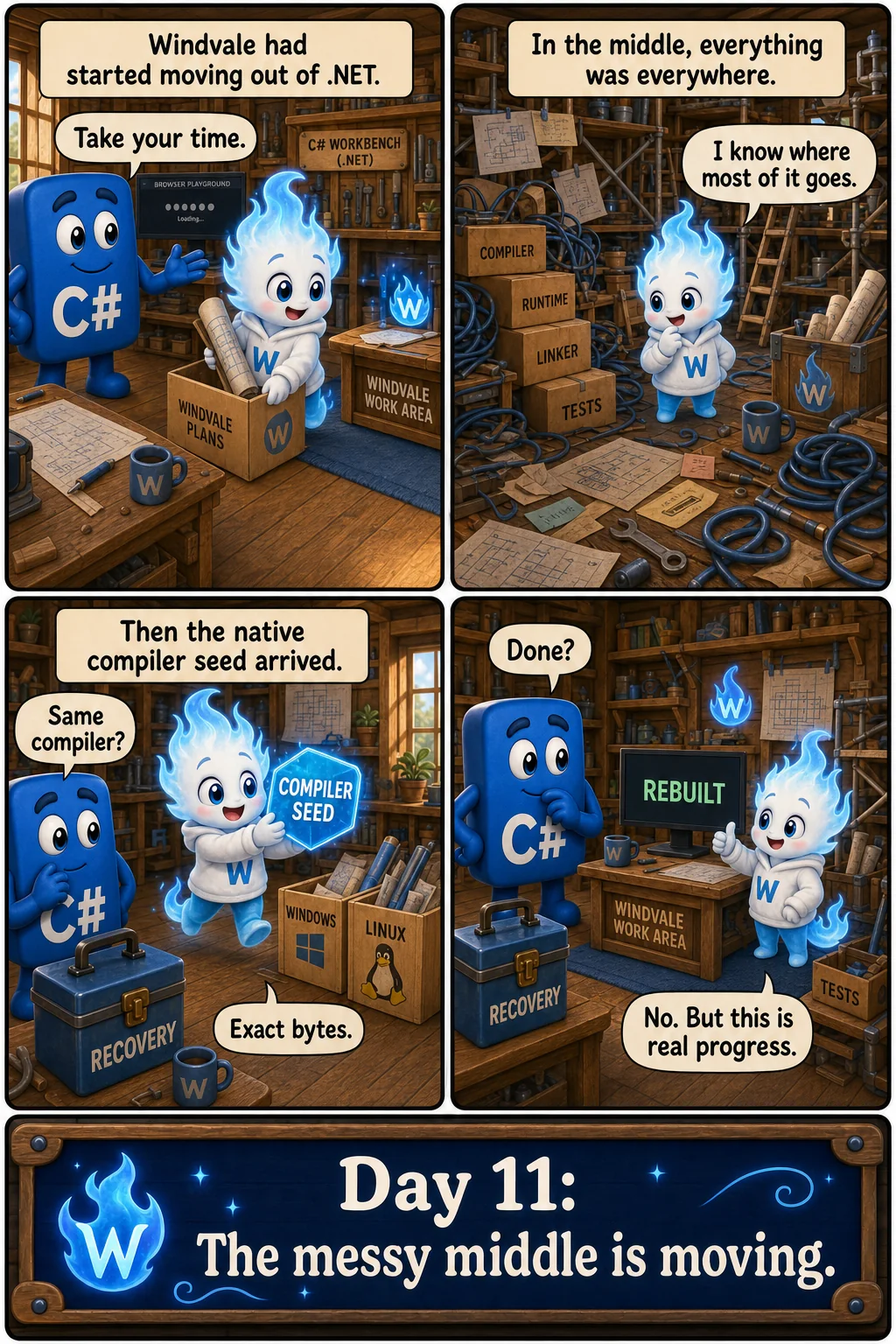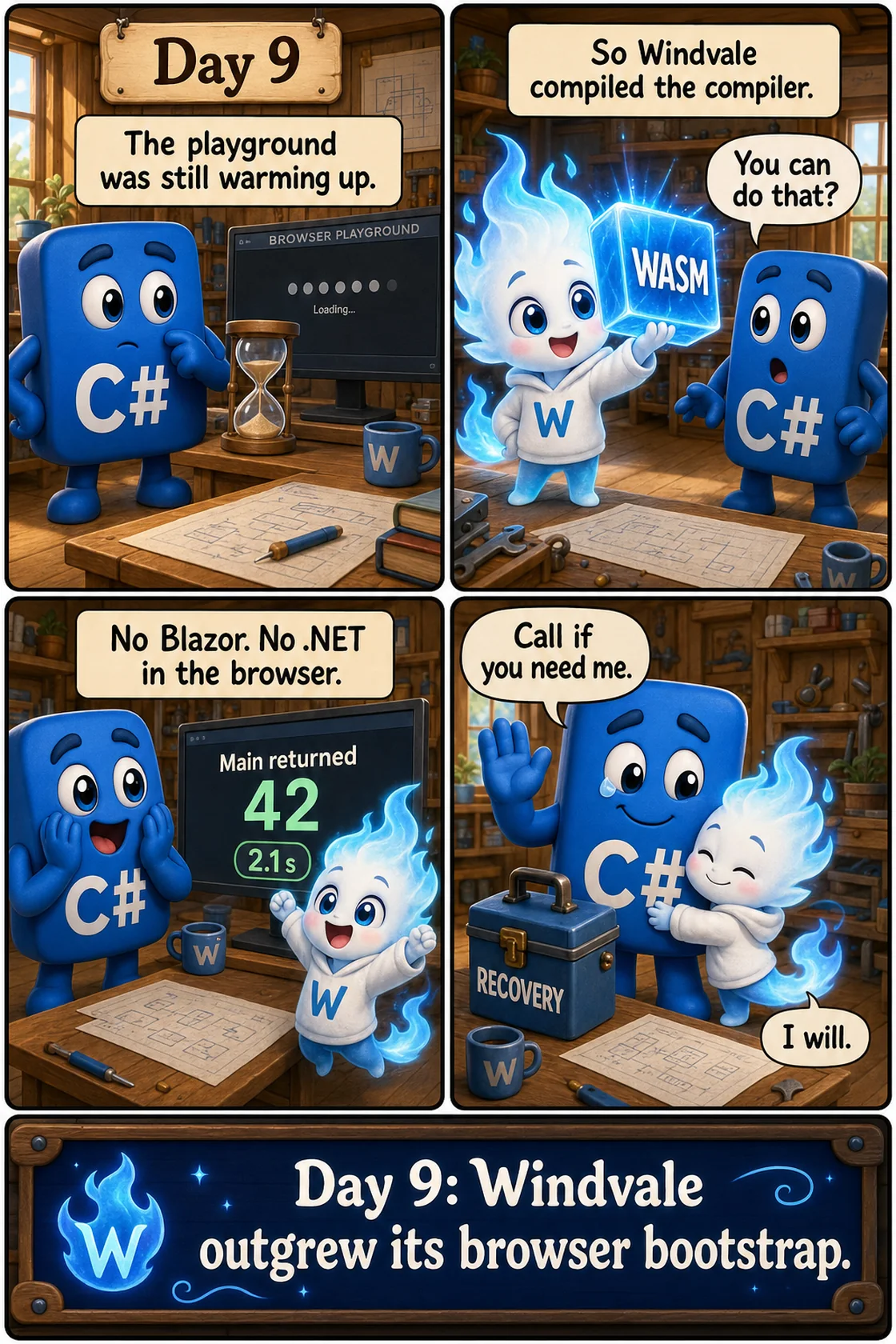
The stack, illustrated

Windvale progress, told as a story.

These dated illustrations make the project's growth easier to follow. They are editorial snapshots; the technical Progress dashboard remains the source of truth.

Newest first

The illustrated archive.

Four chapters preserved newest-first with full-resolution originals and accessible transcripts.

Latest story

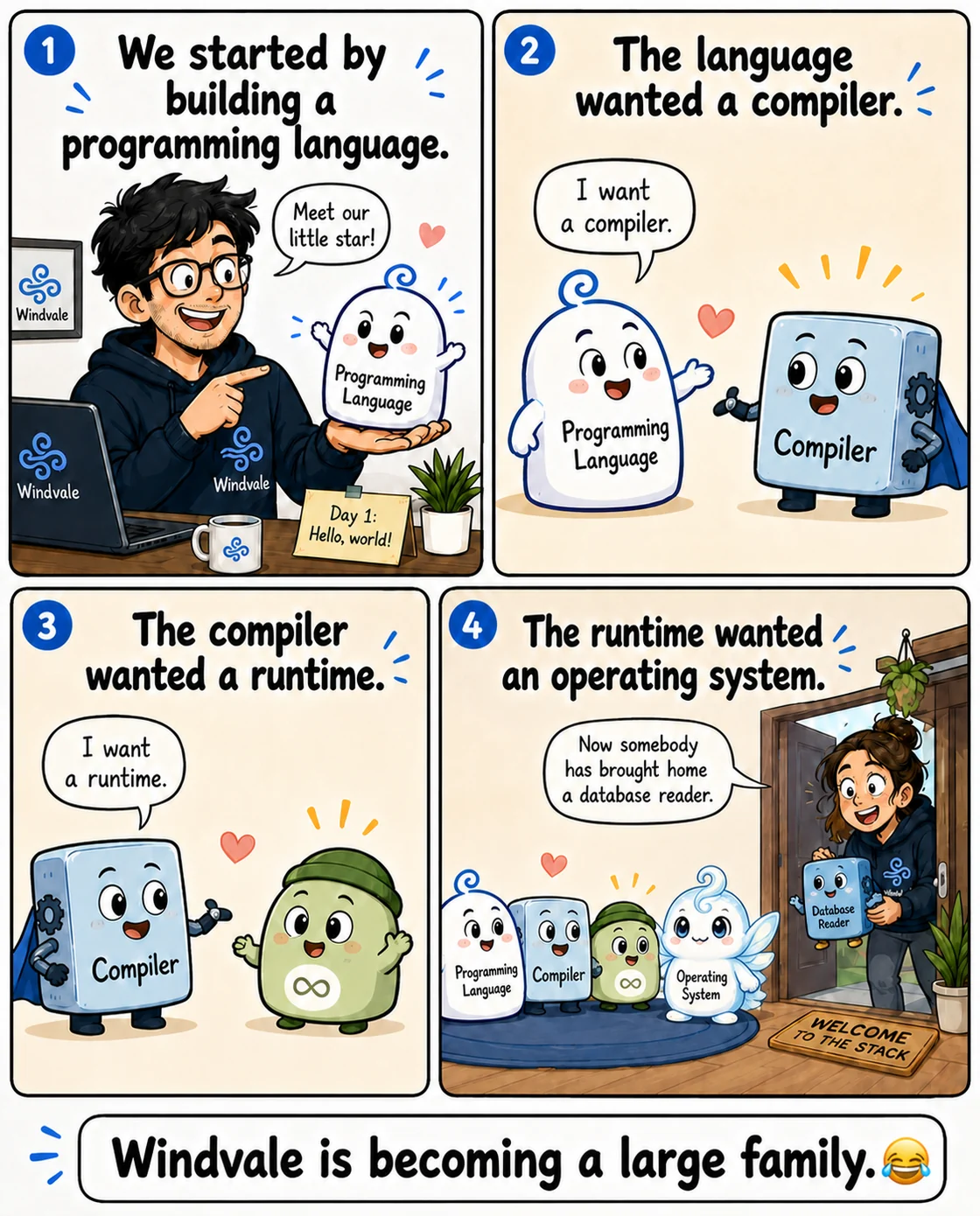
The stack becomes a family.

A small language asks for a compiler. The compiler asks for a runtime. The runtime asks for an operating system—and the project keeps welcoming new members.

Read the comic transcript
  1. Windvale starts by building a programming language: “Meet our little star!”
  2. The programming language says, “I want a compiler.”
  3. The compiler says, “I want a runtime.”
  4. The language, compiler, runtime, and operating-system butterfly welcome a database reader to the stack.
Four-panel comic showing the Windvale language leading to a compiler, runtime, operating system, and database reader.
Architecture portrait

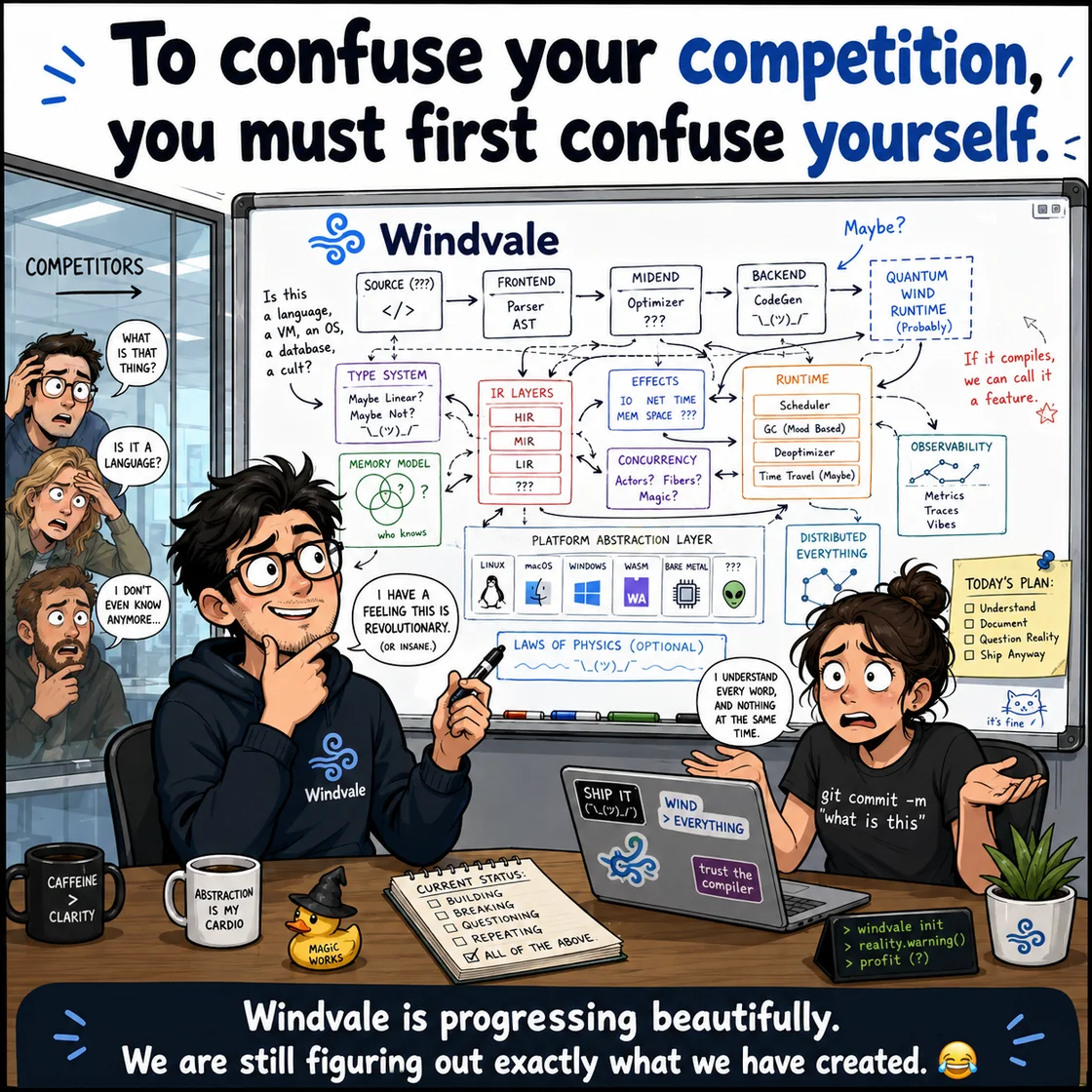
Confusing ourselves into a computing stack.

An early project portrait embraces the uncertainty: language, compiler layers, runtime, effects, concurrency, platforms, observability, and a great many arrows—all progressing beautifully.

Read the illustrated transcript

The headline reads, “To confuse your competition, you must first confuse yourself.” A crowded Windvale whiteboard connects source, frontend, middle-end, backend, type system, IR layers, effects, memory model, concurrency, runtime, observability, platforms, and distributed systems.

Onlookers ask, “What is that thing?”, “Is it a language?”, and “I don't even know anymore.” The builders answer, “I have a feeling this is revolutionary. (Or insane.)” and “I understand every word, and nothing at the same time.” The closing line says Windvale is progressing beautifully while still figuring out exactly what it has created.

Humorous Windvale project portrait with developers facing a whiteboard full of compiler, runtime, platform, and systems ideas.
Day 3

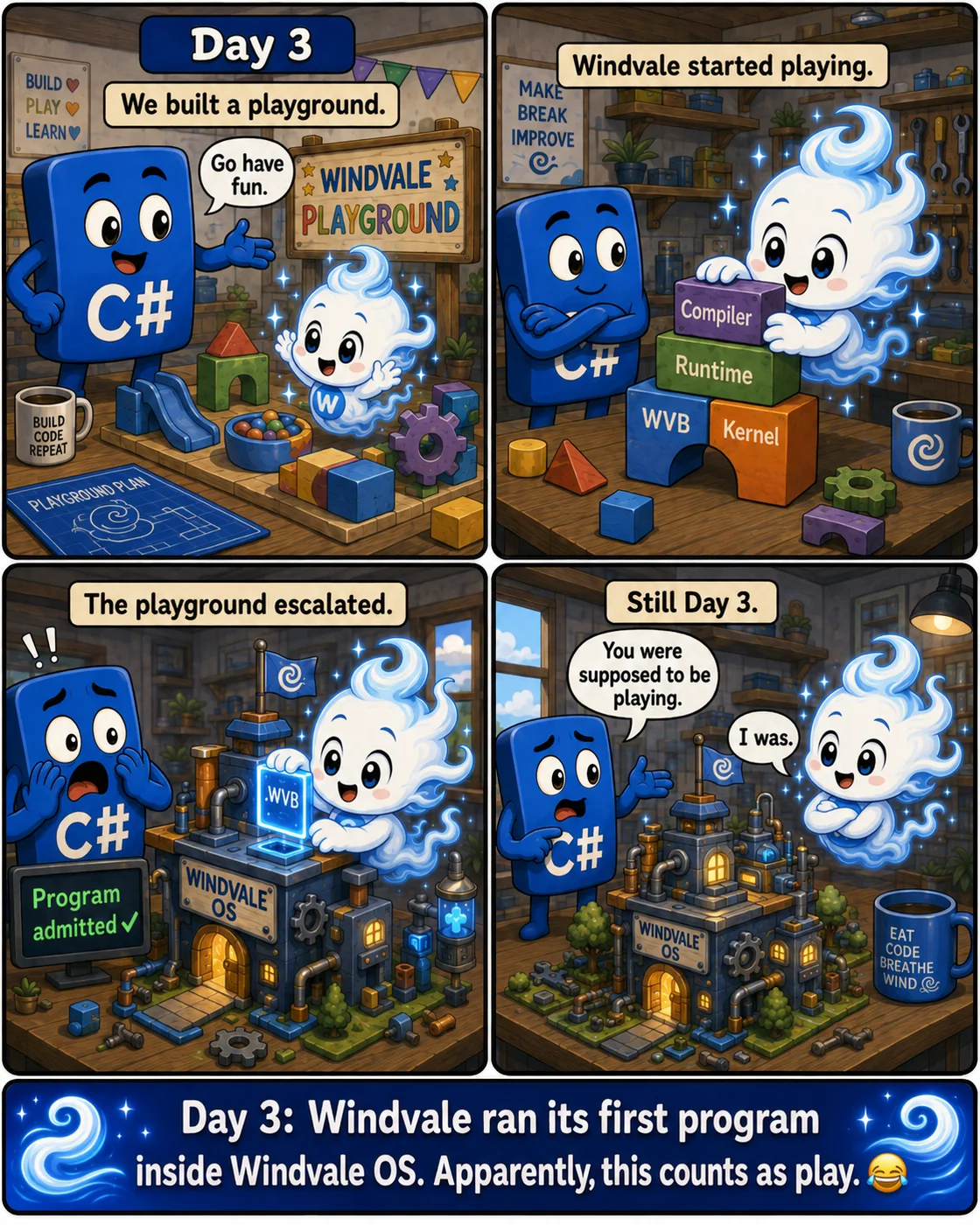
The playground escalated.

Windvale receives a playground and starts stacking compiler, runtime, WVB, and kernel blocks. Playtime ends with the first program running inside Windvale OS—or, as Windvale insists, perhaps that was the play.

Read the comic transcript
  1. Day 3: “We built a playground.” C# tells Windvale, “Go have fun.”
  2. Windvale starts playing by stacking blocks labelled Compiler, Runtime, WVB, and Kernel.
  3. The playground escalates into a Windvale OS machine whose display reports, “Program admitted.”
  4. Still Day 3, C# says, “You were supposed to be playing.” Windvale answers, “I was.” The closing line records Windvale's first program inside Windvale OS.
Four-panel Day 3 comic showing the Windvale playground growing into a Windvale OS machine that runs its first program.
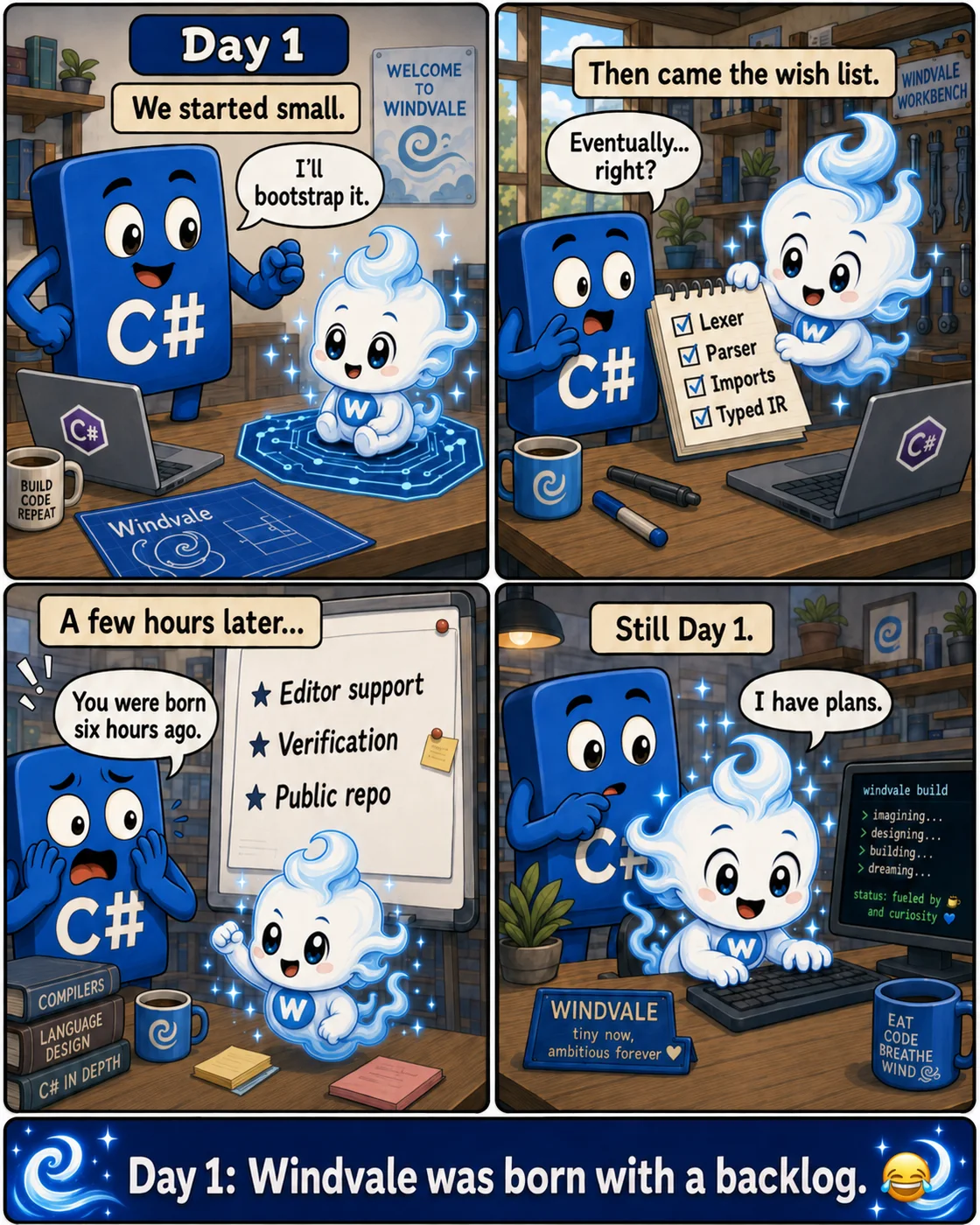
Day 1

Windvale was born with a backlog.

The experiment starts small: C# will bootstrap a tiny Windvale. Within hours, the new language already wants a lexer, parser, imports, typed IR, editor support, verification, and a public repository.

Read the comic transcript
  1. Day 1: “We started small.” C# says, “I'll bootstrap it,” beside the newborn Windvale.
  2. Then comes the wish list: lexer, parser, imports, and typed IR. C# asks, “Eventually… right?”
  3. A few hours later, Windvale adds editor support, verification, and a public repository. C# says, “You were born six hours ago.”
  4. Still Day 1, Windvale types at the computer and says, “I have plans.” The closing line reads, “Day 1: Windvale was born with a backlog.”
Four-panel Day 1 comic showing C# bootstrapping a young Windvale that immediately develops an ambitious backlog.

The full-resolution originals and the process for adding future stories are preserved with the project. Read the publishing guide →